
10 secrets of Barcelona that many locals don't know
A metro station closed since 1972, a skull hidden under a bridge and a square that still bears the marks of war. Ten corners of Barcelona that people pass every day without a second look.
2 April 2025 · 5 min read
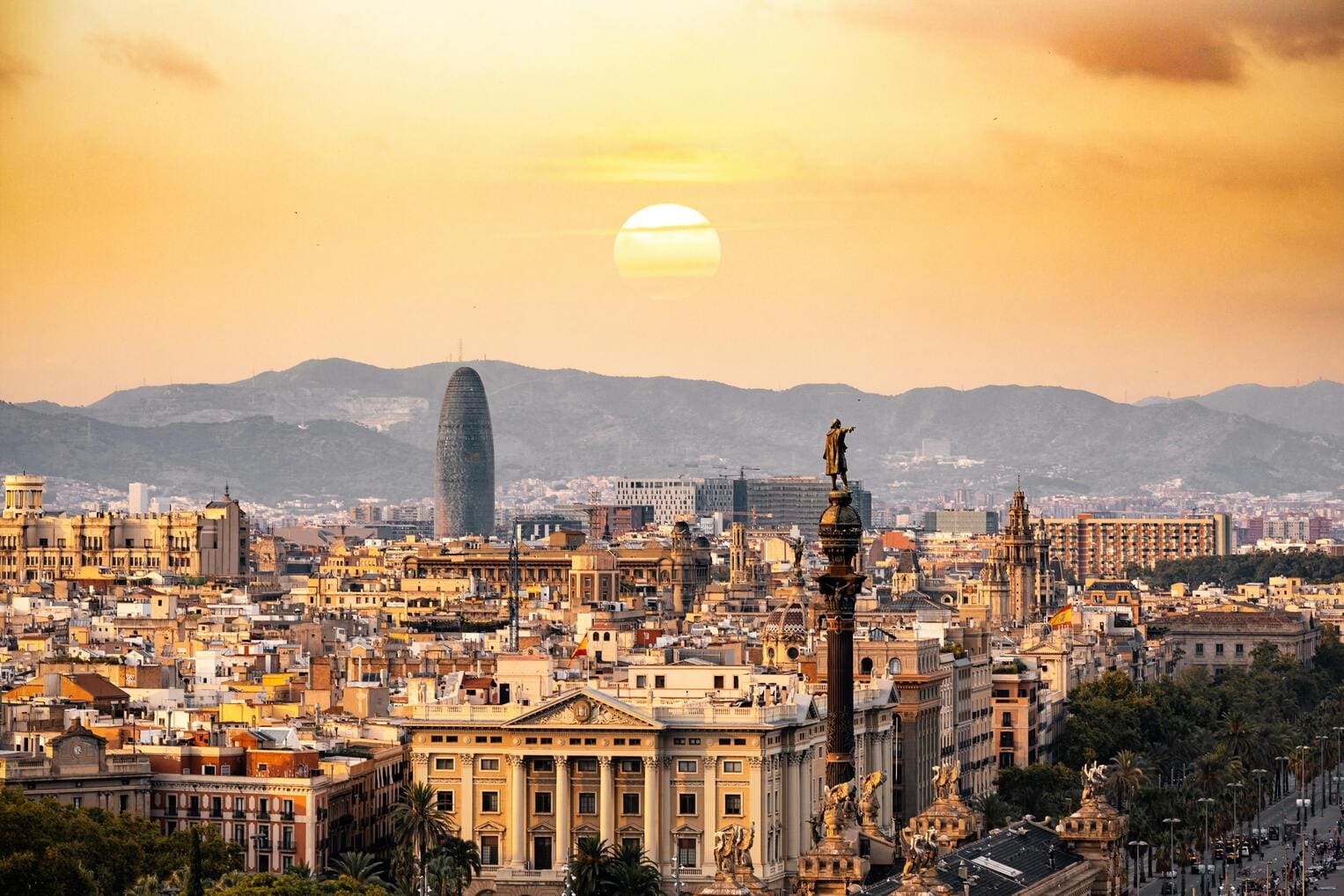
There's far more to Barcelona than the Sagrada Família and the Gothic Quarter. Some places and stories are unknown even to people who have lived here all their lives. If you like to look closely and wonder why things are the way they are, this list is for you.
1. The skull of the Pont del Bisbe
The neo-Gothic bridge over Carrer del Bisbe looks medieval, but it was built in 1928 by the architect Joan Rubió i Bellver, in the run-up to the 1929 Exhibition. Stand underneath it and look up and you'll see a skull pierced by a dagger. Nobody knows for sure why it's there. Legend has it that looking at it brings bad luck, and that if you walk under the bridge backwards without taking your eyes off it, you'll be granted a wish. Take your pick.
2. Poblenou Cemetery
Poblenou Cemetery is one of the oldest in the city. The architect Antonio Ginesi rebuilt it after the first one was destroyed during the Napoleonic occupation, and it was consecrated again in 1819. Its layout is neoclassical, orderly and restrained, with the odd Egyptian touch, although over time it filled up with family tombs in all sorts of styles. Its best-known piece is El Petó de la Mort (The Kiss of Death), from 1930: a winged skeleton kissing a lifeless young man. It's more striking than you'd expect.
3. The ghost station of Correos
Beneath Via Laietana lies a metro station that has been out of use for more than half a century: Correos, on what is now line 4. It opened in 1934 and closed on 20 March 1972, when the line was reorganised to extend it to Barceloneta. It has survived almost like a time capsule, with signs and adverts from the period. There's no access from the street, so it only opens for occasional visits, such as those organised for the metro's centenary in 2025.
4. The Laberint d'Horta
In Horta-Guinardó you'll find the oldest surviving garden in Barcelona. Work began in 1791, commissioned by the Marquis Joan Antoni Desvalls and designed by the Italian Domenico Bagutti. On the lower terrace there's a cypress maze with a statue of Eros at its centre. Getting lost for a while is half the fun. It was later extended with a Romantic section, complete with a waterfall and pavilions.
5. The Carmel bunkers
What everyone calls "the bunkers", at the top of the Turó de la Rovira, are actually the remains of a Republican anti-aircraft battery from the Spanish Civil War, in service from 1938, which defended the city against bombing raids. Today it's one of the most spectacular viewpoints in Barcelona and part of the Barcelona History Museum (MUHBA). Since 2023 the site has closed at night, so in summer you can't always watch the sunset from the top: check the opening hours before you head up.
6. The scars of Plaça de Sant Felip Neri
This little square in the Gothic Quarter is one of the quietest in the old town, which makes what its façade tells you all the more startling. The holes in the church wall are shrapnel marks from the bombing of 30 January 1938. Forty-two people died, most of them children sheltering in the basement. For years people said the marks came from firing squads, but that isn't true. A plaque has commemorated the victims since 2007. It's worth sitting quietly for a moment.
7. The waterfall where a young Gaudí worked
The Cascada Monumental in the Parc de la Ciutadella is the work of the master builder Josep Fontserè, but among his assistants was an architecture student called Antoni Gaudí. Historians agree that he worked on the project, mainly on the hydraulics, though not that he designed it. It's one of the first works on which his name appears.
8. The letterbox of the Casa de l'Ardiaca
At the Casa de l'Ardiaca, next to the cathedral, there's a Modernista letterbox designed by Lluís Domènech i Montaner in 1902, when the building was home to the Bar Association. It features swallows and a tortoise. People often say the swallows stand for how quickly justice ought to act and the tortoise for how slowly it actually does. It's a popular reading, but it's hard to argue with.
9. Carrer dels Petons
In the Sant Pere neighbourhood, near the Arc de Triomf, is Carrer dels Petons, the "street of kisses". It's narrow and dark, and the name has given rise to several stories: that it was a hiding place for lovers, or that condemned prisoners said goodbye to their families here on the way to execution. The more mundane explanation is that it comes from a resident with the surname Pontons, and the name gradually changed over time. None of these versions is fully documented, so feel free to keep the one you like best.
10. Picasso's first steps in Barcelona
Picasso came to Barcelona with his family as a teenager. They lived first in the Porxos d'en Xifré, opposite the Llotja, where he studied fine art, and in the summer of 1896 they moved to number 3 Carrer de la Mercè. That building no longer exists: it was knocked down to open up the square in front of the Basílica de la Mercè. That same year his father rented him his first studio, on Carrer de la Plata, which he shared with his friend Manuel Pallarès. Walking those streets, between the Gothic Quarter and the port, is a way of following his early years in the city.
Barcelona is full of little stories like these. Next time you're wandering around the Gothic Quarter or El Born, look up and take in the details.
If you'd like these corners within walking distance, HiBcn has apartments in several neighbourhoods across the city.
Keep reading
 What's on
Things to do in Barcelona in November 2026
November is when Barcelona goes back to the people who live here. These are this year's festivals, street parties and exhibitions, with dates we've checked.
 Restaurants
Where to eat in Barceloneta: seafood, bombas and vermouth like a local
The real Barceloneta starts two streets back from the beach. These are the neighbourhood bodegas, tapas counters and rice houses we actually go to.
 Restaurants
Where to eat in El Born: bodegas, tapas and Catalan cooking
From the house fizz on Carrer de Montcada to black rice at Santa Caterina market: the El Born places we actually go to when we eat out.