
Staying in Barcelona's Gothic Quarter: a practical guide
Staying in the Gothic Quarter puts old Barcelona right on your doorstep. Here's what's worth knowing to make the most of it: what to see on foot, where to shop, how to get there and what to expect.
20 October 2026 · 7 min read
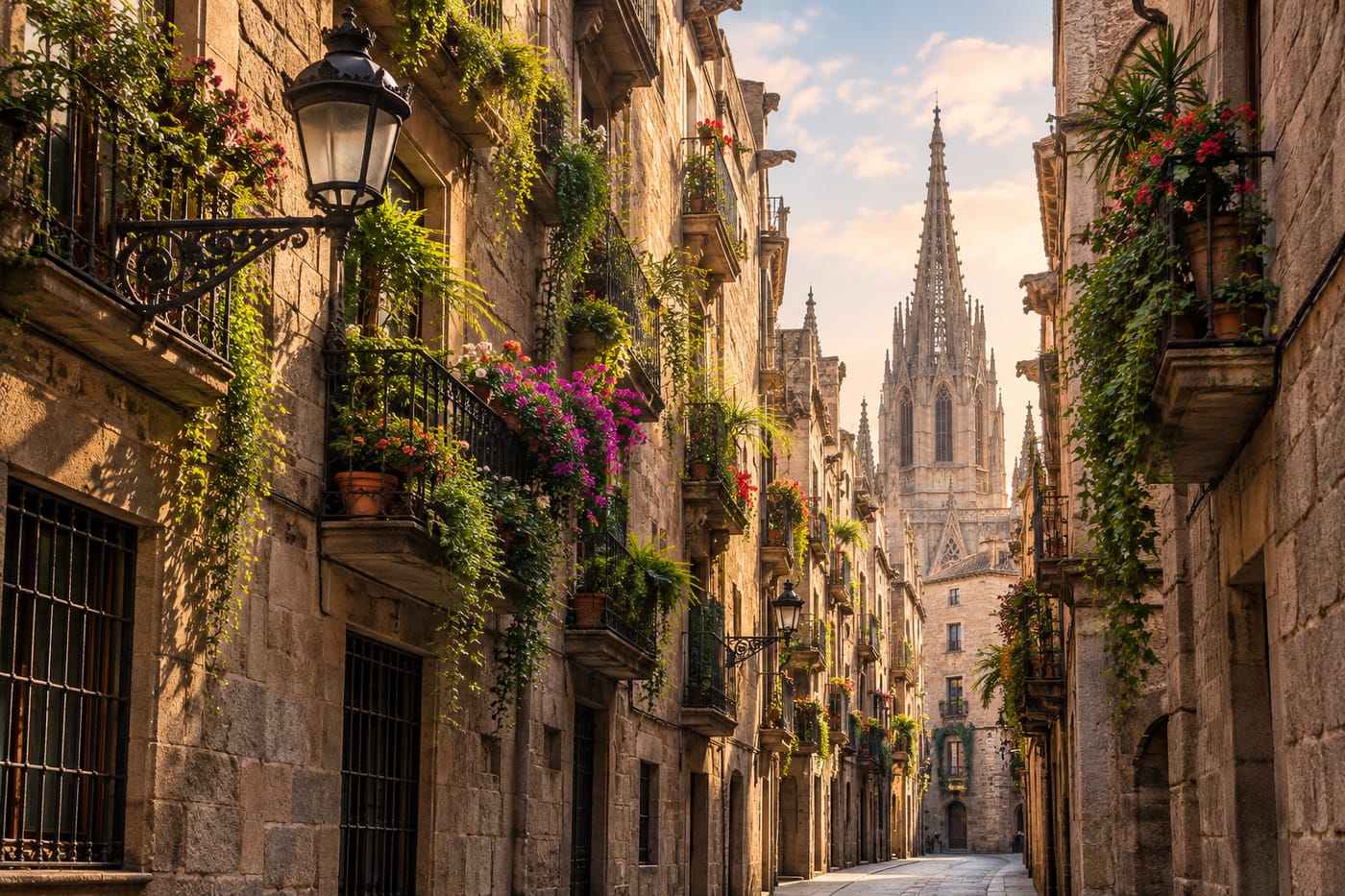
The Gothic Quarter is the oldest part of Barcelona. The Roman city stood here, the Cathedral was built here, and the squares where Catalan and city politics are decided are still here. Today it's also one of the most visited parts of town, which has its good side and its less good side.
Our Gothic Quarter flats are on Carrer d'Obradors, two minutes from Las Ramblas and three from Plaça Reial. We're a family that has been welcoming guests to Barcelona for more than 15 years, and this guide brings together what we usually tell people when they arrive.
Why stay in the Gothic Quarter
The big advantage is that you barely need transport. From the Gothic Quarter you can walk to the Cathedral, La Boqueria, the port and El Born. If you go out for dinner, you walk home. If you forget something at the flat, you're five minutes away.
It's ideal for a first visit, for short breaks when you want to make the most of every hour, and for groups of friends who want to be in the middle of everything. If you're after total silence, or you're travelling with small children who go to bed early, another area may suit you better. We explain the options in our guide to where to stay in Barcelona.
What to see on foot
Everything below can be done in a morning or an afternoon without taking the metro.
The Cathedral and around
Barcelona Cathedral dominates the upper part of the neighbourhood. Around it are some of the most photographed streets in the city, such as Carrer del Bisbe with its neo-Gothic bridge from 1928. Close by is Plaça de Sant Jaume, with the City Hall and the Palau de la Generalitat facing each other.
Roman Barcelona
This neighbourhood was Barcino, the Roman colony. Stretches of the wall survive, and on Carrer del Paradís, inside a courtyard, four columns of the Temple of Augustus still stand, almost nine metres tall. They're run by the Barcelona History Museum (MUHBA), which also has a site on Plaça del Rei. It's a short visit and it surprises almost everyone.
Squares to sit in
- Plaça de Sant Felip Neri: small, with a fountain and a church façade scarred by shrapnel from the 1938 bombing during the Civil War. One of the quietest corners of the neighbourhood.
- Plaça del Pi: beside the church of Santa Maria del Pi, with terraces and plenty going on.
- Plaça Reial: arcaded, with palm trees and street lamps, three minutes from our flats. By day it's a pleasant place for a drink. At night it's one of the liveliest spots in the centre.
Las Ramblas and the port
Las Ramblas run from Plaça de Catalunya down to the sea. They're worth walking once, but it's not where locals eat. At the bottom you reach Port Vell, from where you can carry on to Barceloneta or El Born.
Markets and food
La Boqueria
La Boqueria market is on Las Ramblas, a few minutes' walk from Carrer d'Obradors. It opens Monday to Saturday and closes on Sundays, apart from a few special days around Christmas. Opening times can change and each stall keeps its own hours, so check the market's official website before you go.
Our tip: go early. First thing in the morning it's calmer, and you see it the way residents use it. The stalls by the entrance are the most touristy. Walk towards the back and you'll find more everyday fruit, vegetables, fish and meat.
Santa Caterina
If La Boqueria feels too crowded, Santa Caterina market is across Via Laietana, between the Gothic Quarter and El Born. It's easy to spot thanks to its wavy roof of colourful ceramic tiles. Many people from the old town shop there, and it's a more relaxed experience.
Eating in the neighbourhood
The streets just off Las Ramblas are full of set menus aimed at passing visitors. It's worth heading a little further in: the inner lanes of the Gothic Quarter and El Born have tapas and vermouth bars with far more character. If you're staying in a flat, you can also shop at the market and cook at home, which in Barcelona is a small luxury.
Quieter streets
The Gothic Quarter isn't equally noisy everywhere. Plaça Reial and the streets near Las Ramblas have bars open until late. By contrast, the upper part around the Cathedral and Plaça de Sant Felip Neri, and the lanes of El Call, the old Jewish quarter, are usually much calmer after dark.
For a walk without the crowds, go out early. At eight in the morning the Gothic Quarter is a different place: you can hear the fountains, the bakeries are opening and there are hardly any groups.
Getting there from the airport
Josep Tarradellas Barcelona-El Prat airport has two terminals, T1 and T2. Check which one you land at, because the options vary a little.
Aerobús
The most direct option to the centre. There are two lines: the A1 leaves from Terminal 1 and the A2 from Terminal 2. Both go to Plaça de Catalunya, stopping at Plaça d'Espanya, Gran Via–Borrell and Plaça Universitat. It runs 24 hours a day, every day of the year, and the journey takes about 30 to 35 minutes depending on the time of day. Note that it's a private service, so standard public transport tickets aren't valid.
From Plaça de Catalunya you can walk down Las Ramblas to Carrer d'Obradors, or take the L3 metro one stop to Liceu.
Metro L9 Sud
The L9 Sud line has a station at both terminals. For the Gothic Quarter, the simplest route is to get off at Zona Universitària and change to the L3, which takes you straight to Liceu. It usually takes a little longer than the Aerobús.
Important: the single ticket and the T-casual aren't valid for entering or leaving the airport stations. You need the Airport ticket, sold at the station machines, or the Hola Barcelona travel card, which is valid.
Rodalies train
The R2 Nord line leaves from Terminal 2 and stops at Sants and Passeig de Gràcia. From either, take the L3 to Liceu. If you land at Terminal 1, there's a free shuttle bus between terminals.
Taxi
There are official taxi ranks at both terminals. It's the most comfortable option for a group or if you have lots of luggage. Bear in mind that many Gothic Quarter streets are narrow or pedestrianised, so the taxi may drop you a short walk from the door.
Practical tips
Noise
It's the price of living in the centre. There's life at night, especially at weekends and in summer, and early in the morning the cleaning and delivery lorries come through. If you're a light sleeper, bring earplugs. We're not saying this to put anyone off, but it's better to know before you come.
Old buildings and lifts
Many old buildings in the Gothic Quarter have narrow staircases and not all of them have lifts. If someone in your group has limited mobility, or you're bringing lots of luggage, check the flat's details carefully before booking or ask us.
Suitcases and paving
The streets are stone and some have steps. A suitcase with big wheels helps. If you can travel light, even better.
Pickpockets
Las Ramblas, the metro and crowded areas are where they're most active. Keep your phone and wallet in front of you, don't hang your bag on the back of a terrace chair, and be wary of anyone who approaches with a distraction. It's the same as in any big city, just more concentrated here.
Sundays
Many neighbourhood shops close on Sundays, and so does La Boqueria. Do your shopping on Saturday if you plan to cook.
Tourist tax
Barcelona has a mandatory tourist tax charged per person per night. At our flats it isn't included in the price and you pay it on arrival, by card or in cash.
Arriving at our Obradors flats
Check-in is from 2 pm and check-out is by 11 am. Before you arrive we agree a time with you, and we meet you in person at the flat: we hand over the keys, show you around and tell you what you need to know about the area.
You can see all our flats in the area on the Gothic Quarter and Ramblas page, or search by dates across all our apartments. Booking on our website gets you 8% off the accommodation. And if you're coming to live here for a while, take a look at our monthly stays.
Keep reading
 What's on
Things to do in Barcelona in November 2026
November is when Barcelona goes back to the people who live here. These are this year's festivals, street parties and exhibitions, with dates we've checked.
 Restaurants
Where to eat in Barceloneta: seafood, bombas and vermouth like a local
The real Barceloneta starts two streets back from the beach. These are the neighbourhood bodegas, tapas counters and rice houses we actually go to.
 Restaurants
Where to eat in El Born: bodegas, tapas and Catalan cooking
From the house fizz on Carrer de Montcada to black rice at Santa Caterina market: the El Born places we actually go to when we eat out.